
SIC BO MACAU
Developed by TheVegasLab.com · JAXBIRD LLC
Learn Sic Bo. Master the variants. Understand the odds.
Sic Bo Macau is the most complete Sic Bo simulator available — built for players who want to study every bet on the board, not just click buttons and hope for the best.
Every bet from a real casino Sic Bo table is here. All 50+ bet zones, 4 game variants, 4 regional payout sets, live roadmap trend tracking, hot/cold numbers, and a full session statistics dashboard. The rules, the odds, the payouts — all modeled on real-world casino references.
The marquee mode is Super Sic Bo, the modern live-casino variant where random multipliers up to 1,000× light up the board before each shake. Land a multiplied zone and a single chip can pay back hundreds.
Whether you're a newcomer who just wants to know what "Small" and "Big" mean, or a seasoned player studying Macau vs Atlantic City payout structures — this simulator was built for you.
⚡ Quick Start — Your First Shake in 60 Seconds
- Enter the table — On the setup screen, leave everything at default (Super Sic Bo · Standard payouts · $5 min · $1,000 bankroll) and tap "ENTER TABLE".
- Pick a chip — Tap any denomination in the chip rack at the bottom (try $5).
- Place a bet — Tap the SMALL zone (top-left). Your chip appears on it.
- Shake the dice — Tap the SHAKE button (or press Space).
- See what happens — The three dice tumble and land. If the total is 4 through 10 (and not a triple), SMALL wins and pays 1:1. If the total is 11 through 17 or any triple rolls, SMALL loses. Collect, repeat, or move to another bet.
To remove a chip: right-click (desktop) or long-press (mobile). To replay the exact same bets next round, tap REPEAT. That's it — you're playing Sic Bo.
🎲 What is Sic Bo?
Sic Bo (骰寶, literally "precious dice") is an ancient Chinese casino game played with three dice. According to gaming legend, it has been played at the port of Shanghai for hundreds of years. The modern casino version keeps that long tradition and layers in a wide betting board, fixed payout odds, and an electronic or mechanical dice tumbler.
The aim is simple: predict what the three dice will show. There is no dealer-versus-player duel, no "shooter," no phase cycle — every round is a single shake and every bet on the table resolves at once. A round typically flows like this:
- "Place your bets" — players position chips on the zones of their choice.
- "No more bets" — the betting window closes.
- The shake — the dealer activates the tumbler; the dice tumble at least three times.
- The reveal — the cover lifts, the three values are called, winning zones light up, losing wagers are collected, and winners are paid.
Sic Bo offers one of the widest ranges of bets of any casino game — from even-money picks like Small/Big to long shots like a Specific Triple paying 180:1. This simulator models the full board, every variant, and every payout set — see the rest of this manual for the details.
1. Getting Started
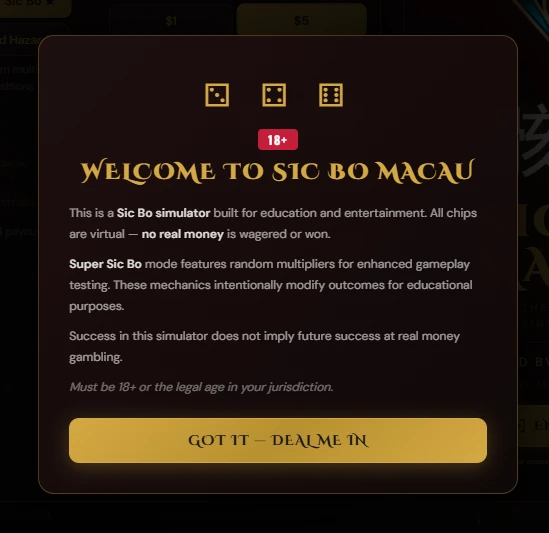
When you launch Sic Bo Macau for the first time, you'll see a welcome screen confirming this is a simulator for education and entertainment — no real money is involved. Tap "GOT IT — DEAL ME IN" to continue. This screen only appears once per device.
The Setup Screen
The setup screen is where you configure your session before stepping up to the table. It's split into three parts: a brand column on the left with the ENTER TABLE button, a settings card in the middle with all the knobs, and a disclaimer strip at the bottom.
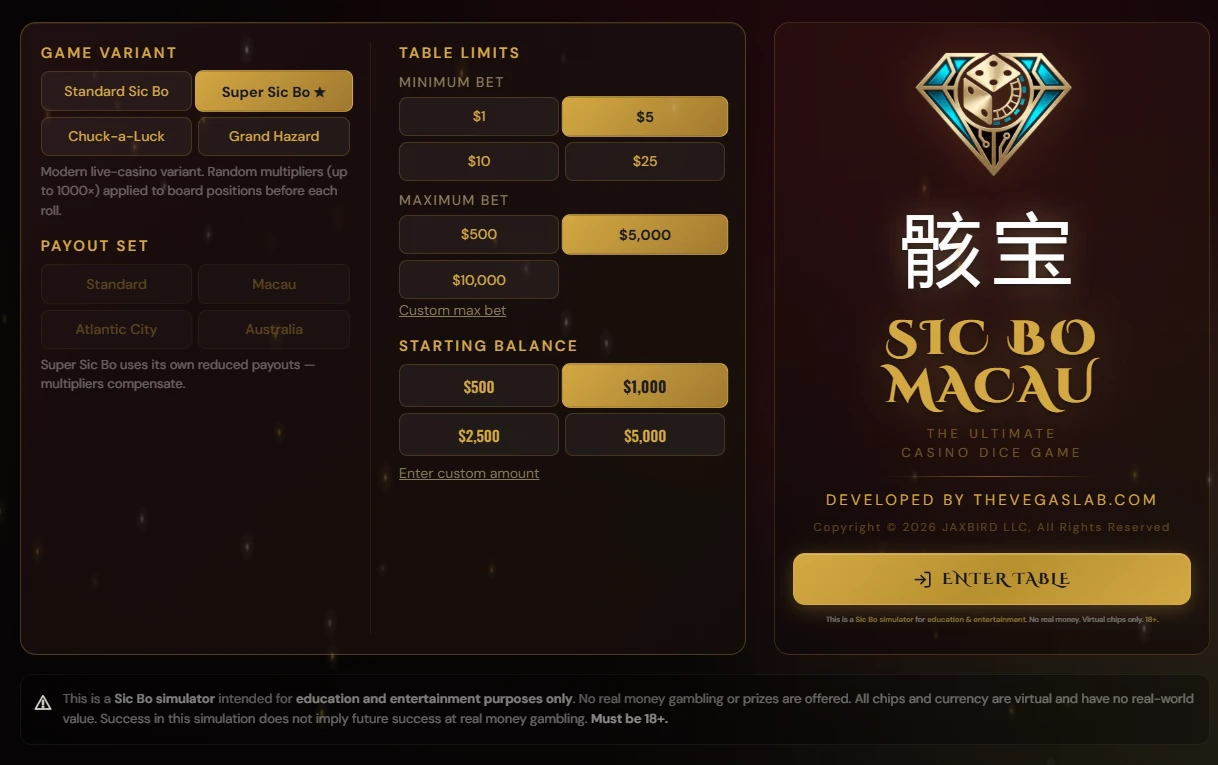
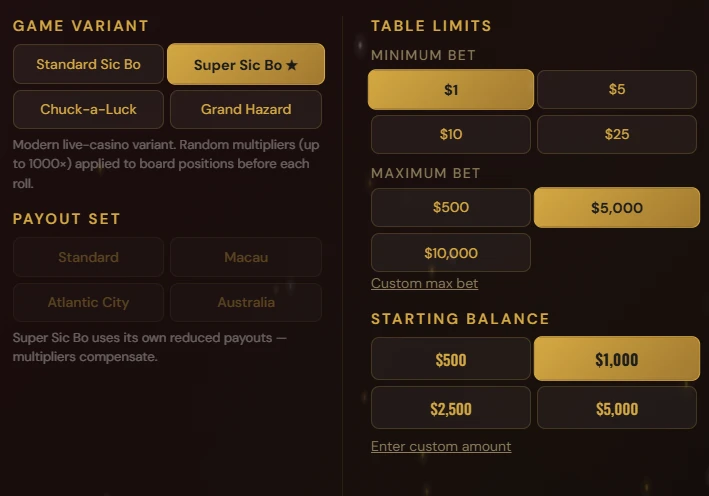
Game Variant
Choose between Standard Sic Bo, Super Sic Bo, Chuck-a-Luck, or Grand Hazard. Each variant is a different game with its own board layout, available bets, and payouts. See Section 6: Game Variants for the full breakdown. Super Sic Bo is the default and flagship mode.
Payout Set
Sic Bo payouts vary by jurisdiction. Choose between Standard, Macau, Atlantic City, or Australia. Each set changes the odds on high-payout bets like triples, doubles, and extreme totals. See Section 8: Regional Payout Sets for the comparison. When Super Sic Bo is selected, a Super payout set is applied automatically — base payouts are reduced to offset the random multipliers.
Table Limits
Minimum Bet — $1, $5, $10, or $25. The smallest wager you can place on a single zone.
Maximum Bet — $500, $5,000, $10,000, or a custom value. The ceiling for any single zone. Tap "Custom max bet" to enter a precise amount.
Starting Balance
Pick from $500, $1,000, $2,500, or $5,000 — or tap "Enter custom amount" to type any value. This is your bankroll for the session.
Custom Amounts
For Maximum Bet and Starting Balance, you can enter custom values instead of the preset buttons. Tap the custom link below each row, type your amount in the text field, and confirm with the checkmark (✓). Your custom value becomes the active setting. Tap ✕ to clear and return to the presets.
Once you're happy with your configuration, tap "ENTER TABLE" to begin.
Auto-Save & Resuming Your Session
Sic Bo Macau automatically saves your session after every round. If you close the browser tab, shut down the app, or your device loses power, your session is preserved — balance, statistics, roadmaps, roll history, and all settings. When you reopen the game, it picks up exactly where you left off.
The only way to reset is to explicitly exit using the EXIT button in the bottom bar. This returns you to the setup screen where you can start a fresh session with new settings. Closing the tab does not reset your session — only the exit button does.
Out of Chips
If your balance reaches zero with no chips on the table, a top-up option appears. Since all chips are virtual, running out is just a learning moment — you can add more and keep studying the same session, or exit and start fresh.
2. The Sic Bo Table
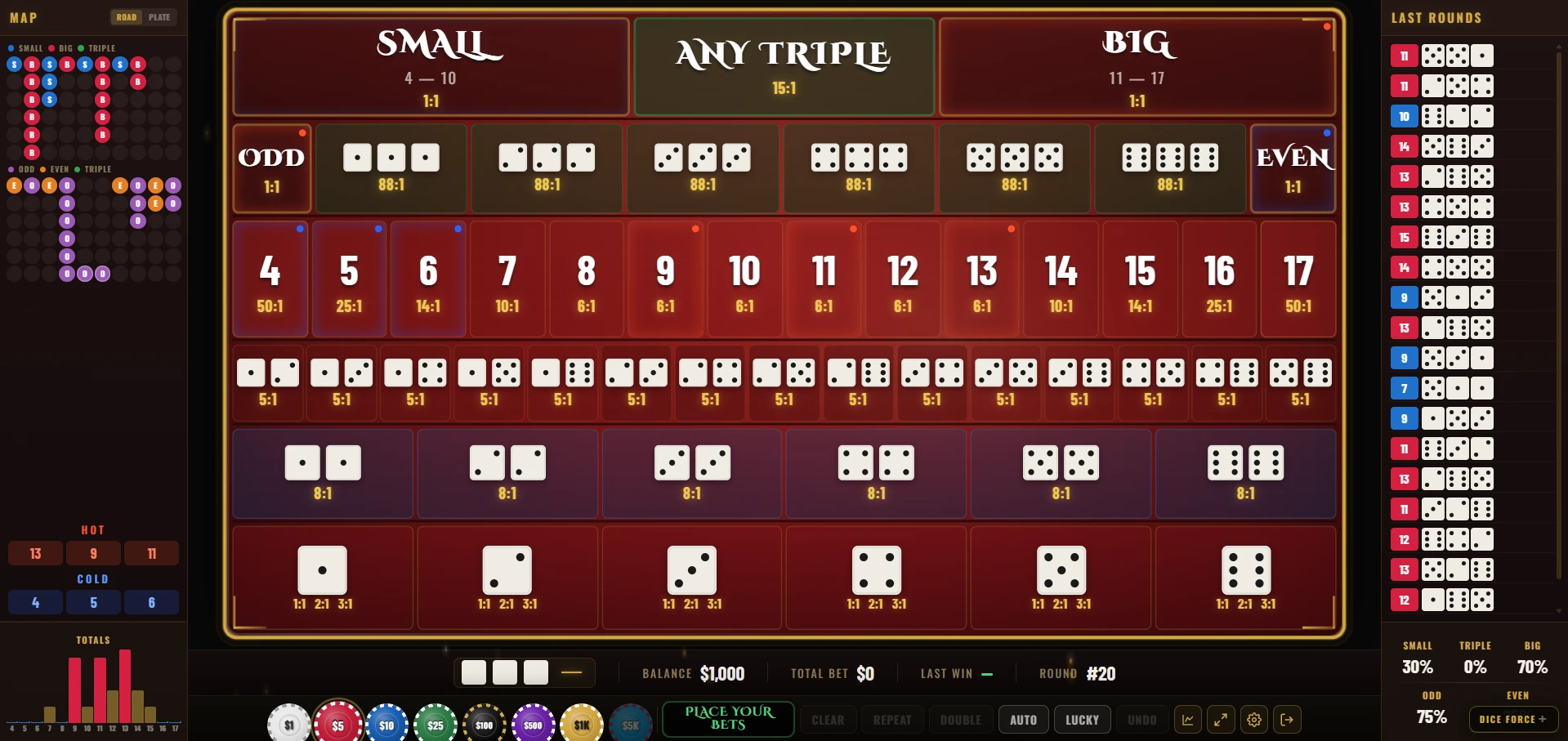
The game screen is a three-column layout: left stats panel, center table, right stats panel, with a bottom bar for controls and an info strip above it for balance and last-roll data.
Top Info Bar
Above the bottom bar, a compact strip shows the current round's context at a glance:
Roll Result — Three small dice rendering the last shake, with the total beside them. Blank until the first shake.
Balance — Your current chip total.
Total Bet — The sum of all chips currently on the table for this round.
Last Win — Your net profit on the most recent round.
Round — Current round number in this session.

The Table Felt
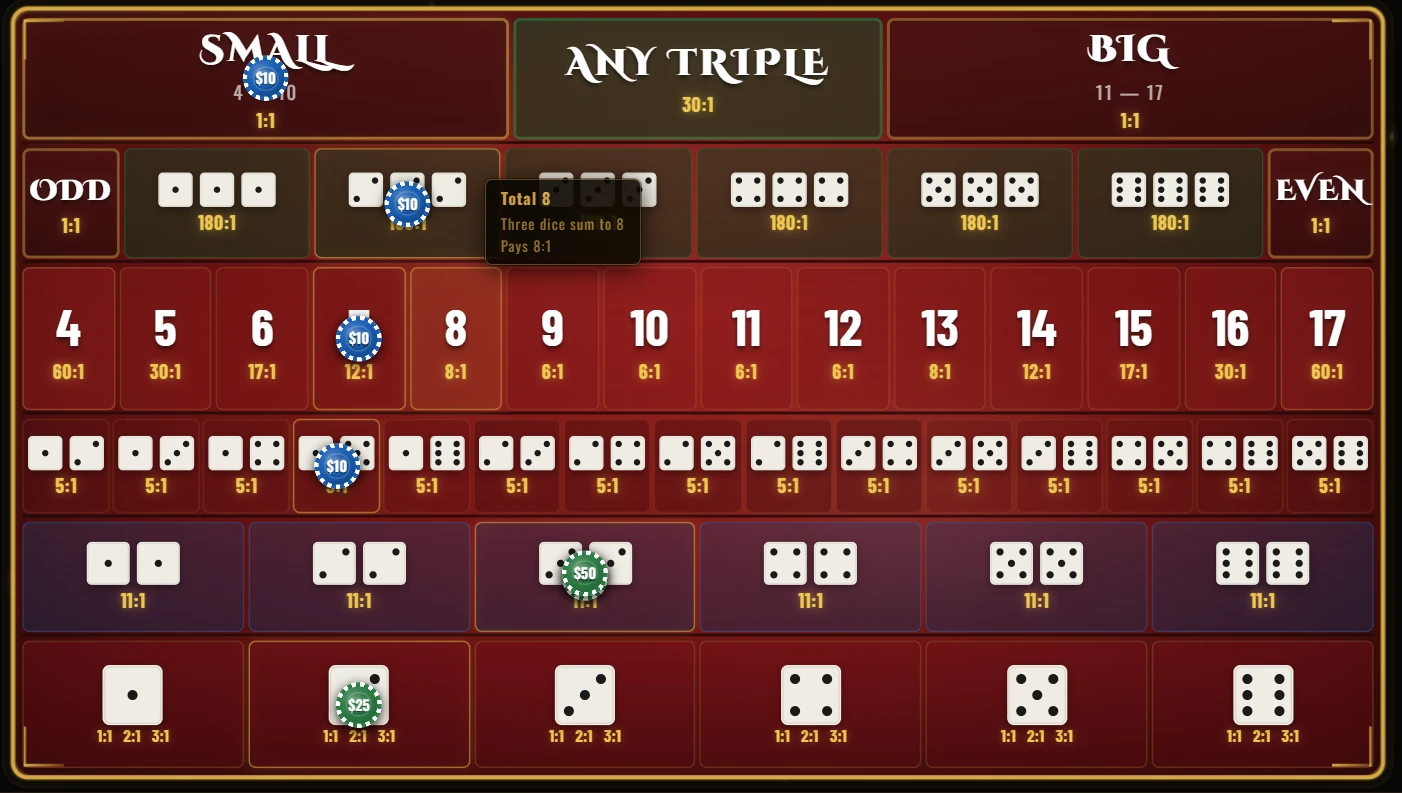
The red felt is laid out in six rows, from the headline zones at the top down to the individual dice bets at the bottom:
| Row | Zones | Bet Type |
|---|---|---|
| 1 | SMALL · ANY TRIPLE · BIG | Even-money totals + any-triple headline |
| 2 | ODD · 6 Specific Triples · EVEN | Parity bets + specific triple grid |
| 3 | Totals 4–17 (14 zones) | Specific total of all three dice |
| 4 | 15 Two-dice Combinations | Specific combo of any two dice |
| 5 | 6 Doubles (1-1 through 6-6) | At least two dice show this number |
| 6 | 6 Singles (1 through 6) | At least one die shows this number |
Every zone is labeled with its payout and, where relevant, the winning range. Hovering over a zone (or long-pressing on mobile) shows a detailed tooltip explaining the rule. After the shake, every zone that matched the dice lights up in a board-wide highlight sweep so you can see exactly which bets won.
The felt itself carries Chinese visual motifs — corner ornaments, a 骰寶 watermark, and a warm red-gold palette — as a nod to the game's Macau / Chinese casino heritage.
Left Panel — MAP (Roadmaps & Histogram)
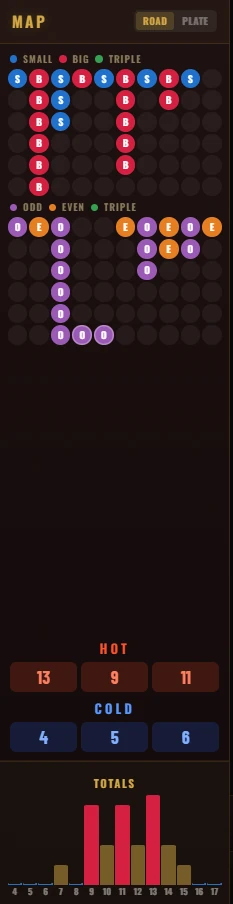
On the left of the table is the MAP panel, which tracks trend patterns across your session:
Big/Small roadmap — A streak-based grid showing which side (Small, Big, or Triple) hit in each round.
Odd/Even roadmap — Same style, tracking parity outcomes.
Hot/Cold strip — The single-die values appearing most and least often recently.
Totals histogram — A bar chart of how often each total from 4 to 17 has come up.
Toggle between Road (Big Road with streak columns) and Plate (Bead Plate, sequential fill) from the header. See Section 9: Roadmaps & Trends for a full breakdown.
Right Panel — LAST ROUNDS
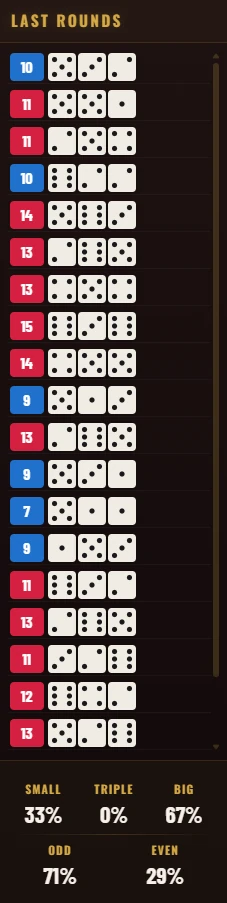
On the right of the table is the LAST ROUNDS panel, a vertical list of recent results. Each entry shows the three dice, the total, and B/S + O/E tags. Below it, a stats footer shows running percentages for Small/Triple/Big and Odd/Even so you can gauge how the session is trending without opening the full stats modal.
Bottom Bar
The bottom bar is your control center.
Chip Rack — Eight denominations from $1 to $5,000. Tap to select, then tap a bet zone to place.
SHAKE — The main action button. Disabled until at least one chip is on the table; reads "PLACE YOUR BETS" until you bet, then "SHAKE". Tap it to begin the dice tumble.
CLEAR — Remove all your bets from the table and return the chips to your balance.
REPEAT — Place the exact same bets you used in the previous round.
DOUBLE — Double every bet currently on the table. Requires enough balance to cover it.
AUTO — Open the Auto-Play popover (see Section 4).
LUCKY — Place a random spread of bets across the board. Great for quick rounds when you don't want to think.
UNDO — Reverse the last chip you placed.
Stats icon — Open the full Session Stats modal.
Fullscreen — Toggle browser fullscreen mode.
Mute — Instantly silence or restore all audio.
Settings — Open the Settings panel.
Exit — End the session and return to the main menu.

3. How Sic Bo Works
Unlike Craps, Sic Bo has no phase system — there's no point, no come-out, no shooter. Every round is a single shake, and every bet on the table resolves on that one shake. Then you clear, re-bet, and go again.
A Round, Start to Finish
- Place your bets. Pick a chip in the rack, tap zones to place chips. You can stack multiple chips on a single zone, spread across as many zones as you like, or use LUCKY to scatter a random spread.
- Tap SHAKE. The button pulses when at least one chip is on the table. Tapping it locks in your bets — no more placement until this round resolves.
- Dice tumble. A 3D dice animation plays — three dice drop, bounce, and scatter across the table into a triangle formation. In real casinos this would be a physical cage or electronic tumbler; here it's modeled after the Evolution-style animation.
- Reveal and resolve. The three values lock in. The board-wide highlight sweep illuminates every zone that matched — if you bet on any of them, you win.
- Payouts and cleanup. Winning bets pay out at the odds listed on their zone; losing chips are swept. Your balance updates, Last Win shows the net, and Round # increments. After a brief celebration (see below), the table clears and you're back to Place your bets.
Win Celebrations
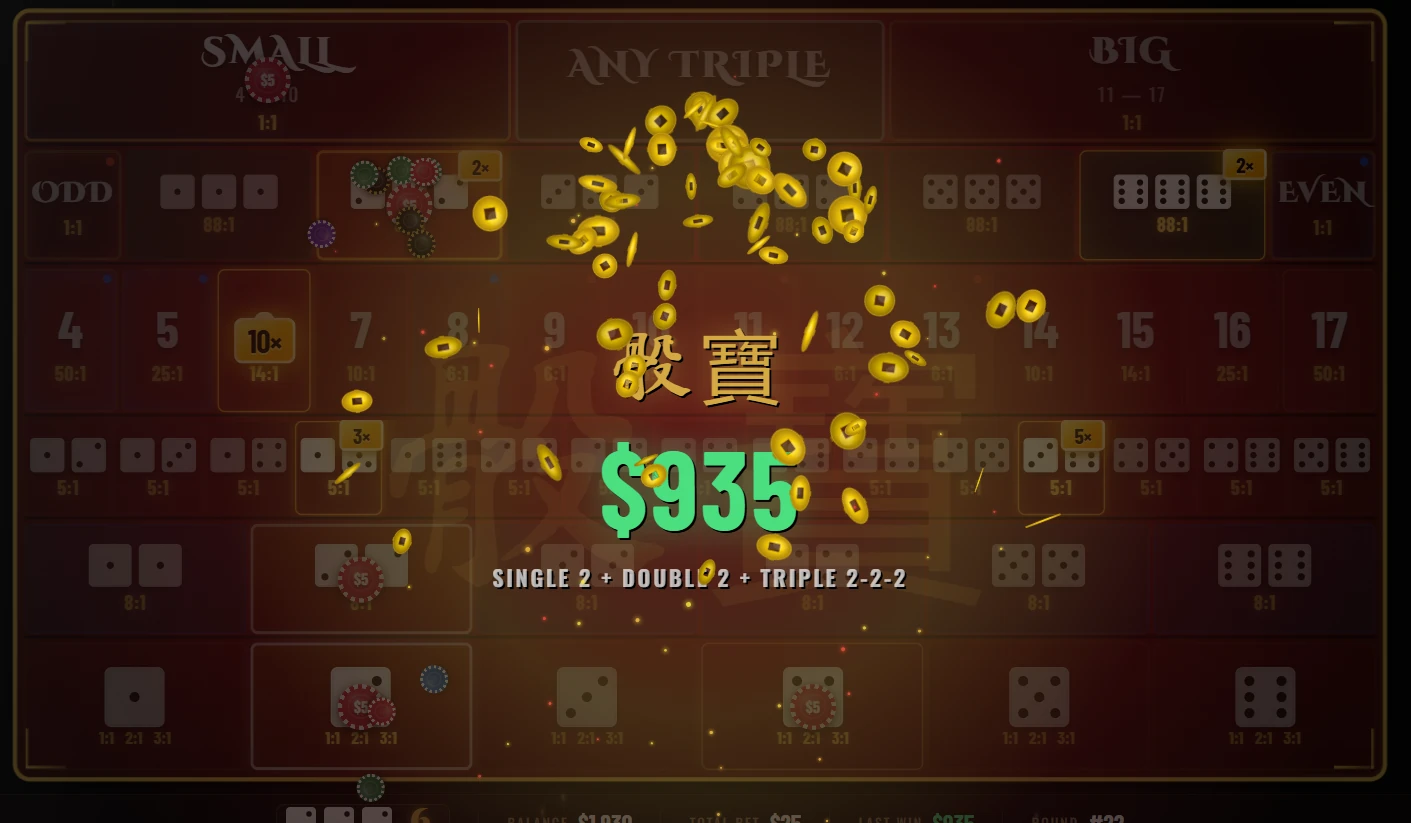
The game grades each winning round into one of four win tiers based on how large the payout is relative to your total bet. Bigger wins trigger bigger celebrations:
| Tier | Trigger | Visual |
|---|---|---|
| Tier 1 | Small net profit | Chip cascade + floating WIN counter on the zone |
| Tier 2 | Solid payout | Full-screen overlay with a gold radial burst + headline |
| Tier 3 | Big multiplier / triple hit | White flash + spark particles + gold coin shower |
| Tier 4 | Huge win (typical of Super Sic Bo multiplier hits) | Screen shake + 骰寶 glyph flash + red-and-gold burst + extended coin shower |
Any overlay can be dismissed with a click or tap so you can keep playing at your own pace.
4. Placing Bets
Selecting a Chip
Tap a chip denomination in the chip rack at the bottom of the screen. The selected chip glows. Available denominations:
| Chip | Color |
|---|---|
| $1 | White |
| $5 | Red |
| $10 | Blue |
| $25 | Green |
| $100 | Black / gold-trim |
| $500 | Purple |
| $1,000 | Gold |
| $5,000 | Cyan / red-trim |
Chips you can't afford are dimmed and unselectable. Chips also obey your table's Minimum Bet — if your selected chip is below the minimum for the zone, placement is blocked.
Placing & Removing Bets
With a chip selected, tap any valid betting zone. Your chip appears on that zone. Tap again to add another chip of the same denomination.
Removing chips:
Right-click (desktop) or long-press (mobile) to remove chips.
Undo button (or press Z) to reverse the last chip placed.
Clear button (or press X) to wipe the entire table and return all chips to your balance.
You can adjust bets freely right up until you tap SHAKE. Once the shake begins, bets lock — real casinos call this the "No More Bets" moment.
Quick Actions
The bottom bar includes quick-action buttons for fast play:
REPEAT — Replay the exact bet layout from the previous round. Enabled after your first completed round.
DOUBLE — Double every bet on the table. If you don't have enough balance to cover it, the action is cancelled with no change.
LUCKY — Scatter a random spread of bets. Uses your selected chip and picks a mix of zones automatically. Great for when you want to keep the action moving without picking each zone manually.
UNDO — Reverse the most recent chip placement. Tap multiple times to undo several bets in a row.
CLEAR — Remove every chip from the table and return the full amount to your balance.
Auto-Play
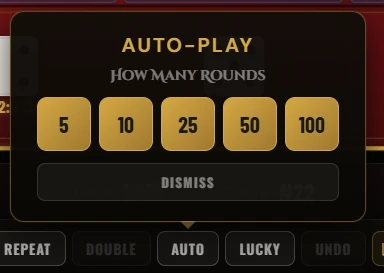
Tap the AUTO button to open the Auto-Play popover. Choose how many rounds to run automatically: 5, 10, 25, 50, or 100. Each round will auto-repeat your current bet layout, auto-shake, resolve, and continue — no manual input required. A progress counter appears on the SHAKE button showing rounds remaining.
Auto-Play stops automatically if you run out of chips, if your balance can't cover the next round's total bet, or if you tap the stop control. It also respects all other game rules — if a round triggers a big win tier, the celebration plays, the payout lands, and the next round continues.
5. All Bet Types Explained
Sic Bo's betting board has 50+ zones grouped into eight categories. Payouts shown below are the Standard set — for regional variations, see Section 8.
Even-Money Bets — Small & Big
The two headline bets at the top of the board. Both pay 1:1 (even money). Both lose on any triple — because if all three dice match, the house takes the bet regardless of the total. This "lose on triple" rule is why the house has an edge even on a 50/50-looking wager.
| Bet | Wins On | Loses On | Payout |
|---|---|---|---|
| Small | Total 4 through 10 | Total 11–17, OR any triple (1-1-1 … 6-6-6) | 1:1 |
| Big | Total 11 through 17 | Total 4–10, OR any triple | 1:1 |
Parity Bets — Odd & Even
Like Small/Big, but based on whether the three-dice total is odd or even. Same "lose on any triple" rule applies.
| Bet | Wins On | Loses On | Payout |
|---|---|---|---|
| Odd | Total of 5, 7, 9, 11, 13, 15, or 17 | Any even total, or any triple | 1:1 |
| Even | Total of 4, 6, 8, 10, 12, 14, or 16 | Any odd total, or any triple | 1:1 |
Any Triple
A single zone that wins if any triple rolls — 1-1-1, 2-2-2, 3-3-3, 4-4-4, 5-5-5, or 6-6-6. You don't pick which triple; any of them counts.
| Bet | Wins On | Payout (Standard) |
|---|---|---|
| Any Triple | Any three matching dice | 30:1 |
Specific Triples
Six zones, one for each value 1 through 6. You're calling your shot — this specific triple will roll. Huge payout, long odds. The probability of any single specific triple is 1 in 216.
| Bet | Wins On | Payout (Standard) |
|---|---|---|
| Triple 1-1-1 | All three dice show 1 | 180:1 |
| Triple 2-2-2 | All three dice show 2 | 180:1 |
| Triple 3-3-3 | All three dice show 3 | 180:1 |
| Triple 4-4-4 | All three dice show 4 | 180:1 |
| Triple 5-5-5 | All three dice show 5 | 180:1 |
| Triple 6-6-6 | All three dice show 6 | 180:1 |
Doubles
Six zones, one per value. Wins if at least two dice show that number — so a Double 4 wins on 4-4-anything (including 4-4-4). You're not betting on the specific third die.
| Bet | Wins On | Payout (Standard) |
|---|---|---|
| Double 1 | Two or three dice show 1 | 11:1 |
| Double 2 | Two or three dice show 2 | 11:1 |
| Double 3 | Two or three dice show 3 | 11:1 |
| Double 4 | Two or three dice show 4 | 11:1 |
| Double 5 | Two or three dice show 5 | 11:1 |
| Double 6 | Two or three dice show 6 | 11:1 |
Specific Totals (4 through 17)
Fourteen zones — one for each possible total of the three dice. Payouts are symmetric around the middle (10 and 11 are the most common totals; 4 and 17 are the rarest with only one combination each).
| Total | Ways to Roll | Payout (Standard) |
|---|---|---|
| 4 or 17 | 1 combination (rarest) | 60:1 |
| 5 or 16 | 3 combinations | 30:1 |
| 6 or 15 | 6 combinations | 17:1 |
| 7 or 14 | 9 combinations | 12:1 |
| 8 or 13 | 12 combinations | 8:1 |
| 9 or 12 | 15 combinations | 6:1 |
| 10 or 11 | 15 combinations (most common non-triple totals) | 6:1 |
Two-Dice Combinations (Dominoes)
Fifteen zones — one for each unique pair of different dice values. You win if those two values both appear on at least two of the three dice (the third die can be anything). Also called domino bets because the zones often display the two dice side-by-side like domino tiles.
| Combination | Wins On | Payout (Standard) |
|---|---|---|
| 1 & 2 | Any roll containing both a 1 and a 2 | 5:1 |
| 1 & 3 | Any roll containing both a 1 and a 3 | 5:1 |
| … (15 total) | All pairs from 1&2 through 5&6 | 5:1 |
| 5 & 6 | Any roll containing both a 5 and a 6 | 5:1 |
Single Dice Bets
Six zones, one per value. You're betting that at least one die will show your chosen number. The payout scales with how many dice actually match:
| Match Count | Example (on Single 4) | Payout (Standard) |
|---|---|---|
| One die matches | 4-?-? where the other two ≠ 4 | 1:1 |
| Two dice match | 4-4-? where the third ≠ 4 | 2:1 |
| Three dice match | 4-4-4 | 3:1 |
6. Game Variants
Sic Bo Macau includes four variants. All use three dice and share the same core shake-and-reveal loop, but the board, available bets, and payout logic differ significantly.
Standard Sic Bo
Classic Macau / casino Sic Bo. The full board you see on most real tables — Small/Big, Odd/Even, Any Triple, Specific Triples, Doubles, Totals 4–17, two-dice Combinations, and Singles. This is the baseline variant used as the reference for all rules in this manual.
Super Sic Bo ★ FLAGSHIP
The modern live-casino variant. Same board as Standard, but before each shake, 3 to 6 zones light up with random multipliers — anywhere from 2× up to 1,000×. If a multiplied zone wins, your base payout is multiplied. Base payouts are reduced to offset the multipliers, but the ceiling is dramatically higher. See Section 7 for the full mechanics.
Chuck-a-Luck
A simplified variant derived from English Grand Hazard. Historically played with three dice in a rotating wire cage (hence "Birdcage"). The focus is on single-number bets — players pick numbers 1 through 6, with payouts scaling by how many dice match. In Sic Bo Macau, Chuck-a-Luck keeps the simplified layout with singles and a small subset of common bets.
Mathematically, Chuck-a-Luck is a subset of Sic Bo — every Chuck-a-Luck bet exists in Standard Sic Bo, but the reduced board makes for a simpler, carnival-style session.
Grand Hazard
An English three-dice game closely related to Sic Bo. The board focuses on Totals, Triples (called "raffles"), and Single-dice bets, with fewer of the exotic combination zones found on a full Sic Bo table. Structure is the same — one shake, fixed payouts — but the betting menu is leaner and more classical.
Variant Comparison
| Feature | Standard | Super Sic Bo | Chuck-a-Luck | Grand Hazard |
|---|---|---|---|---|
| Small / Big | ✓ | ✓ | — | — |
| Odd / Even | ✓ | ✓ | — | — |
| Any Triple | ✓ | ✓ | — | ✓ |
| Specific Triples | ✓ | ✓ | — | ✓ |
| Doubles | ✓ | ✓ | — | — |
| Totals 4–17 | ✓ | ✓ | — | ✓ |
| Two-Dice Combos | ✓ | ✓ | — | — |
| Singles (1–6) | ✓ | ✓ | ✓ | ✓ |
| Random multipliers | — | ✓ (up to 1,000×) | — | — |
| Base payout reduced | — | Yes (offsets multipliers) | — | — |
7. Super Sic Bo & Multipliers
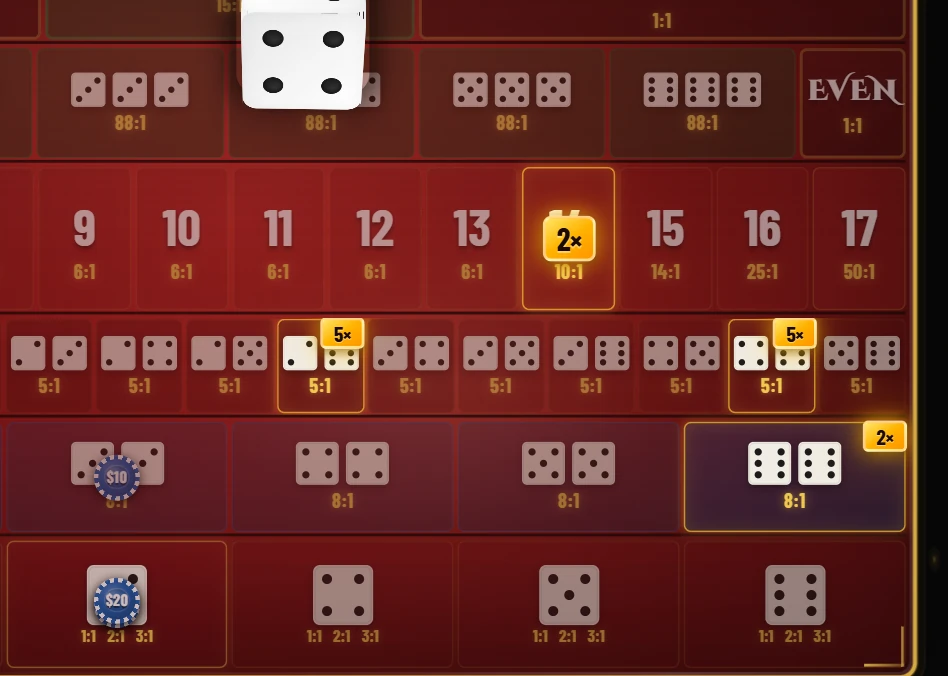
Super Sic Bo is the marquee variant. Before each shake, the game picks a random set of zones and assigns each a multiplier. If you have a bet on a multiplied zone and that zone wins, your payout is multiplied.
How the Multipliers Work
- Before the shake, Super Sic Bo rolls a pre-round generator. It picks between 3 and 6 zones (typically 4), chooses a multiplier for each from a tier-specific pool, and paints the multiplier values onto those zones as gold badges.
- You place bets normally. A chip on a multiplied zone isn't any more expensive — but the potential payout is amplified if that zone hits.
- Dice roll and resolve. Any non-multiplied winning zone pays at its reduced Super base rate. Any multiplied winning zone pays base × multiplier.
- Next round, the multipliers clear and new ones are generated.
Which Zones Can Be Multiplied
Not every zone is eligible. Even-money bets (Small, Big, Odd, Even) and Single-dice bets are always excluded — they keep their flat base payouts round to round. Only the higher-variance zones qualify:
| Tier | Eligible Zones | Multiplier Pool | Typical Weighting |
|---|---|---|---|
| Tier 1 | All 15 Two-Dice Combinations | 2×, 3×, 5×, 8×, 10×, 15× | Low values most common; 15× rare |
| Tier 2 | All 14 Totals (4–17) + all 6 Doubles | 2×, 3×, 5×, 8×, 10×, 20×, 50× | 2×–10× common; 20× rare; 50× very rare |
| Tier 3 | Any Triple + all 6 Specific Triples | 2×, 3×, 5×, 8×, 10×, 20×, 50×, 88× | Heaviest jackpot tier |
Reduced Base Payouts
Because multipliers can push payouts into the stratosphere, Super Sic Bo uses a compressed base payout table. This keeps the long-term math honest and matches how real live-casino Super Sic Bo games (like Evolution's) balance the mode.
| Bet | Standard Payout | Super Sic Bo Base Payout |
|---|---|---|
| Specific Triple | 180:1 | 88:1 |
| Any Triple | 30:1 | 15:1 |
| Double | 11:1 | 8:1 |
| Total 4 / 17 | 60:1 | 50:1 |
| Total 5 / 16 | 30:1 | 25:1 |
| Total 6 / 15 | 17:1 | 14:1 |
| Total 7 / 14 | 12:1 | 10:1 |
| Total 8 / 13 | 8:1 | 6:1 |
| Small / Big / Odd / Even | 1:1 | 1:1 (unchanged) |
| Single Dice | 1:1 / 2:1 / 3:1 | 1:1 / 2:1 / 3:1 (unchanged) |
The Payout Cap
To keep extreme combinations from producing unbounded wins, Super Sic Bo applies a $999 cap per $1 wagered — matching the real-world Evolution Super Sic Bo cap. A $1 chip on a specific triple at base 88:1 with a stacked 88× multiplier would theoretically pay 7,744:1; with the cap it pays 999:1. The cap only kicks in for genuinely rare combinations.
8. Regional Payout Sets
Real Sic Bo payouts vary between jurisdictions. A specific triple might pay 150:1 in Macau, 180:1 in most US casinos, 195:1 in Singapore, or be called a "31:1 any triple" at an Australian table. Sic Bo Macau models four distinct regional sets so you can study the difference.
You choose the payout set on the setup screen. It applies to Standard, Chuck-a-Luck, and Grand Hazard. When Super Sic Bo is selected, the Super base payout set is used automatically instead.
Comparison Table
| Bet | Standard | Macau | Atlantic City | Australia |
|---|---|---|---|---|
| Specific Triple | 180:1 | 150:1 | 180:1 | 180:1 |
| Any Triple | 30:1 | 24:1 | 30:1 | 30:1 |
| Double | 11:1 | 8:1 | 10:1 | 11:1 |
| Two-Dice Combo | 5:1 | 5:1 | 5:1 | 5:1 |
| Total 4 / 17 | 60:1 | 50:1 | 60:1 | 62:1 |
| Total 5 / 16 | 30:1 | 18:1 | 30:1 | 31:1 |
| Total 6 / 15 | 17:1 | 14:1 | 17:1 | 17:1 |
| Total 7 / 14 | 12:1 | 12:1 | 12:1 | 12:1 |
| Total 8 / 13 | 8:1 | 8:1 | 8:1 | 8:1 |
| Total 9 / 12 | 6:1 | 6:1 | 7:1 | 7:1 |
| Total 10 / 11 | 6:1 | 6:1 | 6:1 | 6:1 |
| Single (1 die match) | 1:1 | 1:1 | 1:1 | 1:1 |
| Single (2 dice match) | 2:1 | 2:1 | 2:1 | 2:1 |
| Single (3 dice match) | 3:1 | 3:1 | 3:1 | 12:1 |
| Small / Big / Odd / Even | 1:1 | 1:1 | 1:1 | 1:1 |
Picking a Payout Set
Standard — The benchmark set used in most US casinos and many online Sic Bo games. A good middle ground and the best default for learning the game.
Macau — Tighter payouts across the top tier (triples and doubles). Reflects the higher house edge common in mainstream Macau casino Sic Bo tables.
Atlantic City — Mostly matches Standard, but improves Double (10:1 → looks worse but check carefully — this set actually pays 10:1 instead of 11:1 on Doubles and bumps Totals 9/12 from 6:1 to 7:1. A slight trade-off in the player's favor on totals, slight cost on doubles.
Australia — The most player-friendly set. Matches Standard on most zones, but pays 62:1 on Total 4/17 (vs 60:1), 31:1 on Total 5/16 (vs 30:1), 7:1 on Total 9/12, and — most notably — 12:1 on a triple-match Single bet instead of 3:1. That last one is a huge boost on an otherwise mediocre wager.
9. Roadmaps & Trends
Sic Bo Macau includes a full suite of trend-tracking tools built into the live UI — no need to open a menu. These are the same kinds of displays used at live Asian casino tables for Baccarat and Sic Bo, adapted to the Sic Bo board.
The MAP Panel
The left-side MAP panel shows two roadmaps stacked vertically:
Big/Small roadmap — Tracks whether each round landed Small (total 4–10), Big (11–17), or a Triple.
Odd/Even roadmap — Tracks the parity of each round's total. Triples are shown here too since they break both Small/Big and Odd/Even.
Each roadmap can be toggled between two display styles:
Big Road — Streak-based columns. A new round that matches the previous one stacks vertically; a change starts a new column to the right. Long columns signal "dragon tails" — extended streaks. This is the classic Asian casino roadmap style.
Bead Plate — Sequential fill, left-to-right, top-to-bottom. Each round gets the next cell in order. Easier to read total counts at a glance but doesn't visualize streaks as clearly.
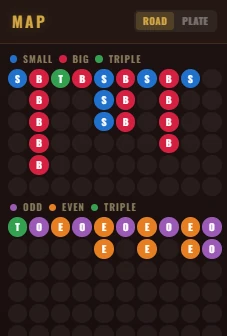
The roadmap uses a fixed FIFO window — as new rounds come in, the oldest results drop off the left edge. Column count adapts to viewport: typically 7, 8, or 10 columns depending on screen size. There's no scrollbar by design.
Hot & Cold Strip
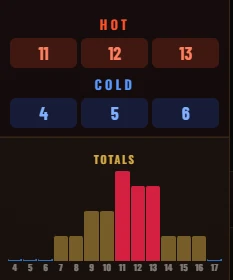
Below the roadmaps, a Hot/Cold strip highlights which single-die values (1–6) have been appearing most and least often recently. HOT numbers are running ahead of expected frequency; COLD numbers are running behind. These are purely descriptive — dice have no memory, and past results don't predict future ones — but they're a staple of casino trend displays and useful for spotting variance in the short run.
Totals Histogram
Below the hot/cold strip is a horizontal bar chart covering every possible total from 4 to 17. Each bar's height shows how many times that total has come up this session, with color coding highlighting hot (overperforming) and cold (underperforming) totals relative to their theoretical frequency.
Last Rounds Panel
The right-side LAST ROUNDS panel is a vertical list, newest round on top. Each entry shows the three dice, the total, and tags marking whether it was Small/Big and Odd/Even (triples show a dedicated triple tag). Below the list, three percentage readouts track Small % / Triple % / Big % and Odd % / Even % for the session. Triples are excluded from the Odd/Even percentages (they don't count toward either side).
Mobile Trend Strip
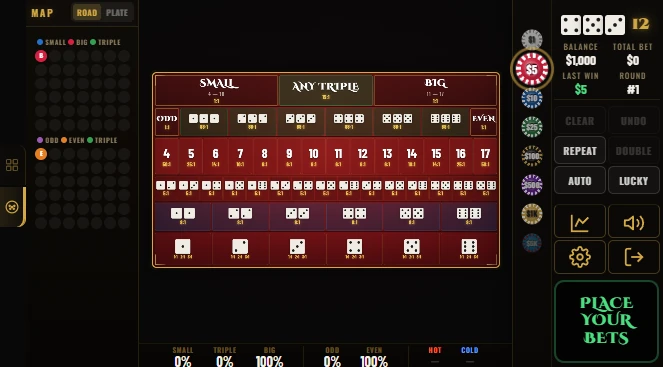
On mobile, where the side panels collapse into drawers, a compact horizontal trend strip sits directly below the table. It shows Small % / Triple % / Big %, Odd % / Even %, and the current hot and cold numbers — all the key trend info in one glance-friendly row.
10. Session Statistics
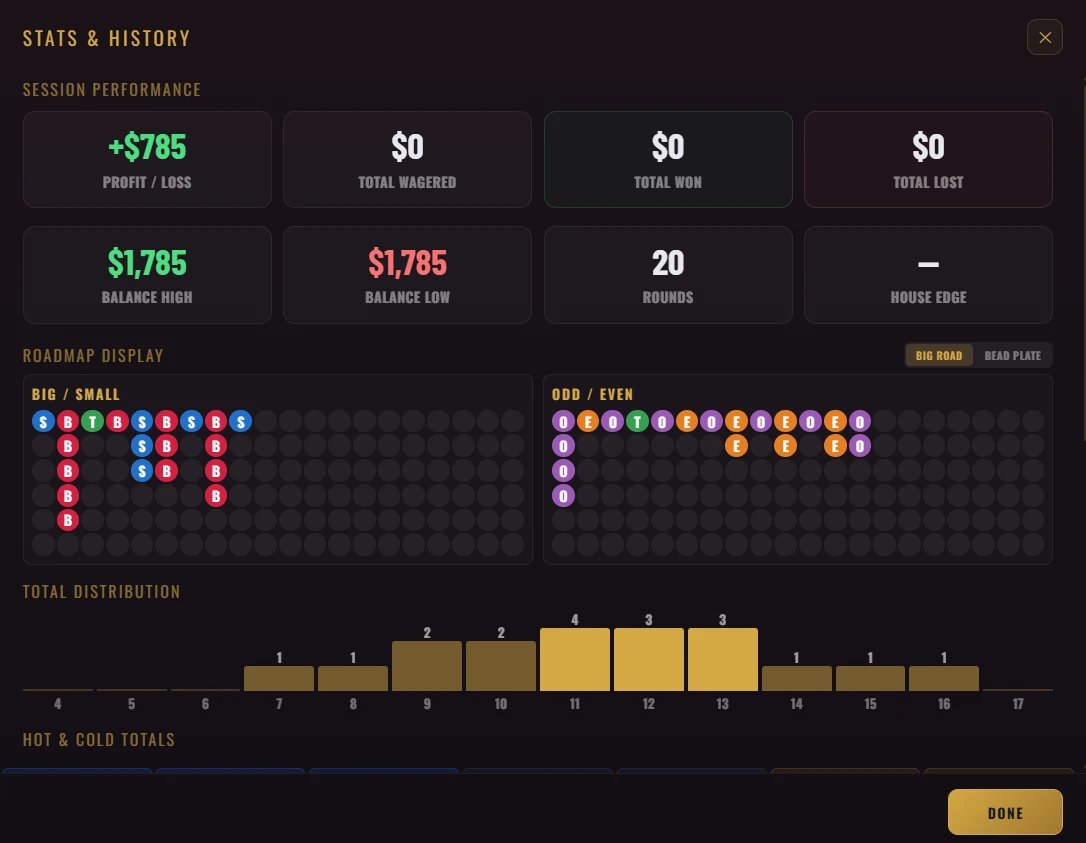
Tap the stats icon in the bottom bar (chart icon) to open the full Session Stats modal. It expands on everything shown in the live trend panels and adds session performance cards.
What's Inside
Expanded roadmaps — Up to 40 columns wide, showing much more history than the live panels.
Full totals histogram — All 14 totals with exact count and frequency.
Performance cards — Total rounds, total wagered, total won, current balance, session high, session low, longest win streak, best single win, and the zone that produced it.
Last 20 rounds — A detailed grid of the most recent rounds with dice faces and tags.
Opening the modal pauses the game — shake and autoplay are blocked while it's open, so you can study the numbers without the table rolling on without you. Tap outside or press Escape to close.
11. Settings
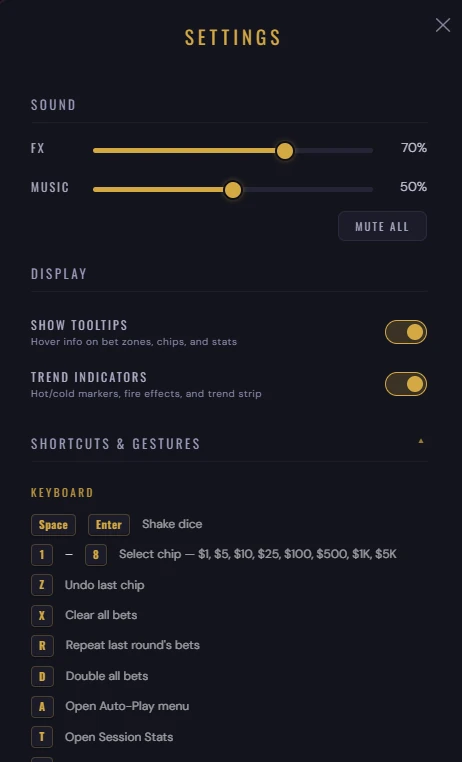
Tap the gear icon in the bottom bar to open the Settings panel. Adjust audio, display, and session options.
Audio
FX volume — Controls dice shake sounds, chip placement, win celebrations, coin showers, and UI clicks. Independent slider.
Music volume — Controls the ambient background soundtrack. The music ducks automatically during win celebrations so the celebration audio is clearly audible, then fades back up.
Master Mute — The mute button on the bottom bar (or press M) silences all audio at once without changing your volume settings. Tap again to restore.
When you switch tabs or minimize the window, all audio pauses and animation loops stop — when you return, they resume automatically. This prevents audio leaking over other work and stops particle effects from piling up while the tab is hidden.
Display
Show Tooltips — Toggle the hover / long-press descriptions on bet zones, chips, and stats panels. Turn them off once you know the board by heart.
Trend Indicators — Show or hide the hot/cold dots on bet zones and the on-board trend strip. Handy for a cleaner look during focused play.
Pinch to Zoom (mobile only) — Enable two-finger pinch-to-zoom and drag-to-pan on the table. Disabled by default to prevent accidental zooming. When enabled, double-tap anywhere to reset the zoom, and a floating reset button appears when you've zoomed in.
Session
The settings panel also includes the Exit to Main Menu path — this ends the current session and returns you to the setup screen. Session stats and balance reset; configuration preferences (variant, payout set, limits) are remembered and pre-filled on the setup screen.
12. Keyboard Shortcuts & Gestures
Keyboard Shortcuts
Shortcuts work during the betting phase (when the SHAKE button is available). They're disabled while typing in input fields and while modals are open, so they never interfere with data entry.
| Key | Action | Notes |
|---|---|---|
Space or Enter | Shake the dice | Only works when at least one chip is on the table |
1–8 | Select chip denomination | 1 = $1, 2 = $5, 3 = $10, 4 = $25, 5 = $100, 6 = $500, 7 = $1K, 8 = $5K. Unavailable chips are skipped. |
Z | Undo last chip | Same as the UNDO button |
X | Clear all bets | Same as the CLEAR button |
R | Repeat last round's bets | Requires a previous completed round |
D | Double all bets | Requires enough balance to cover the double |
A | Open Auto-Play popover | Then tap a round count pill |
S | Open Settings panel | Blocked while the table is locked mid-shake |
T | Open Session Stats modal | |
M | Mute / Unmute all audio | Works in any phase |
Escape | Close modal / popover | Settings, Stats, Auto-Play popover |
Mouse Controls (Desktop)
| Action | Effect |
|---|---|
| Click bet zone | Place one chip of the selected denomination |
| Right-click bet zone | Remove one chip from that zone |
| Hover over bet zone or chip | Show tooltip with payout and bet rule |
Touch Gestures (Mobile)
| Gesture | Effect |
|---|---|
| Tap bet zone | Place one chip of the selected denomination |
| Long-press bet zone | Remove one chip (same as right-click on desktop) |
| Long-press stats / label | Show tooltip with details |
| Pinch (two fingers) | Zoom in/out on the table (must be enabled in Settings) |
| Drag (while zoomed) | Pan around the table |
| Double-tap | Reset zoom to full table view |
13. Mobile Play
Sic Bo Macau runs in Safari (iOS) and Chrome (Android). The mobile layout reflows the three-column desktop layout into a stacked one-column design optimized for landscape orientation.
Landscape Required
The game is designed for landscape only. If you hold the device in portrait, a rotate prompt appears asking you to turn the device sideways. This keeps the table layout readable at any mobile size.

Drawer Tabs
On mobile, the left MAP panel and right LAST ROUNDS panel collapse into drawer tabs on the edge of the screen. Tap the rounds tab to open the Last Rounds drawer, or the maps tab to open the Roadmaps drawer. Tap the backdrop or the same tab again to close.
Trend Strip Below Table
To make sure you always see some trend information without opening a drawer, a compact trend strip sits directly below the table on mobile. It shows Small % / Triple % / Big %, Odd % / Even %, and current Hot/Cold numbers. This strip is always visible.
Pinch-to-Zoom
Off by default. Enable from Settings → Display → Pinch to Zoom. When on, two-finger pinch zooms into any area of the table, drag pans while zoomed, and double-tap resets. A floating Reset Zoom button appears in the corner once you've zoomed in, so you can snap back to the full table view in one tap.
14. Tips for New Players
15. Glossary
| Term | Definition |
|---|---|
| 骰寶 (Sic Bo) | Chinese for "precious dice." The traditional name of the game. |
| Tai Sai / Dai Siu | Alternative Chinese names for Sic Bo, meaning "big small." |
| Big | A 1:1 bet that the three-dice total will be 11–17 (loses on any triple). |
| Small | A 1:1 bet that the three-dice total will be 4–10 (loses on any triple). |
| Triple | Three dice showing the same value (1-1-1, 2-2-2, etc.). Also called "three of a kind." |
| Any Triple | A bet that wins on any triple regardless of value. |
| Specific Triple | A bet on a named triple (e.g., Triple 4-4-4). The biggest single-zone payout on the board. |
| Double | A bet that at least two of the three dice will show a specific number. |
| Total / Total Value Bet | A bet on the exact sum of all three dice (ranges from 4 to 17). |
| Two-Dice Combination | A bet on a specific pair of different values appearing on any two of the three dice. Also called a domino bet. |
| Single / Single Dice Bet | A bet on a specific number; payout scales with how many of the three dice match. |
| Tumbler / Shaker | The cage or electronic device used to shake the dice in real casinos. |
| No More Bets | The dealer's call that closes the betting window. Once called, no wagers can be placed, increased, or withdrawn. |
| Round of Play | One complete cycle from "place your bets" to "payouts settled." |
| No Roll | An irregular shake where a die doesn't come to rest flat. The round is voided and rolled again. |
| Chuck-a-Luck | A simplified three-dice game derived from Grand Hazard, focused on single-number bets in a "birdcage" tumbler. |
| Grand Hazard | An English three-dice game closely related to Sic Bo, with a leaner betting menu focused on totals, triples, and singles. |
| Super Sic Bo | A modern live-casino variant that adds random multipliers (up to ~1,000×) to selected zones before each shake. |
| Dragon Tail | An unusually long streak on the Big Road roadmap — a single column that extends well below the grid. |
| Big Road | The classic Asian casino roadmap style: new streak values start a new column; matching values stack vertically. |
| Bead Plate | An alternative roadmap style: results fill left-to-right, top-to-bottom in sequence. |
| Hot / Cold | Single-die values appearing more (hot) or less (cold) often than their theoretical 1-in-3 per-roll frequency. |
| Macau | The world's largest casino gambling hub and the spiritual home of modern Sic Bo. The Macau payout set reflects the tighter payouts typical of Macau tables. |
| House Edge | The casino's mathematical advantage over the player on a given bet, expressed as a percentage. |
| Even Money | A bet that pays 1:1 — your wager back plus an equal amount. Small, Big, Odd, and Even are all even-money bets. |
| Multiplier (Super Sic Bo) | A random boost applied to one of 3–6 eligible zones before a shake. If that zone wins, the base payout is multiplied. |
This is a Sic Bo simulator for education and entertainment. No real money gambling. All chips are virtual. 18+.
Sic Bo Macau — The Ultimate Casino Dice Game
© 2026 JAXBIRD LLC. All Rights Reserved.
Developed by TheVegasLab.com